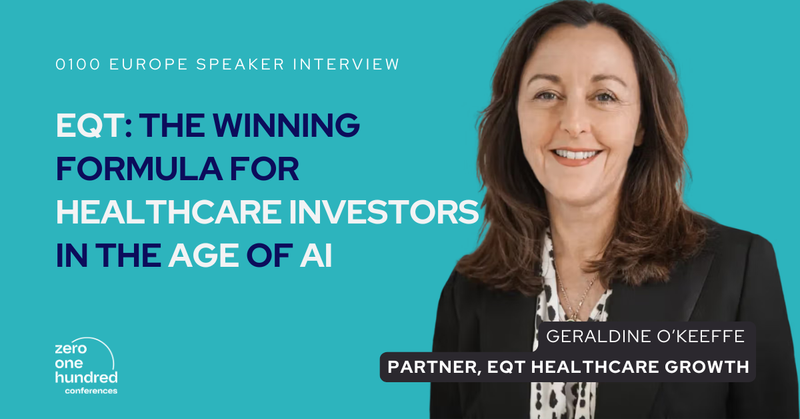
As private equity adapts to a prolonged high-cost environment, investors are being forced to rethink how they source deals, create value, and deploy capital. Ahead of her appearance at 0100 Europe (April 21–23), we spoke with Geraldine O’Keeffe, Partner at EQT Healthcare Growth, about how one of Europe’s leading investment platforms is transiting today’s market dynamics—across healthcare, technology, and beyond.
How is dealmaking in 2026 shaping up compared to last year?
From EQT’s perspective, the fundamentals remain consistent, but the level of selectivity has increased. The firm continues to focus on its core pillars—technology and healthcare—but within those sectors, there is much greater nuance.
“In a high-cost environment, we’re spending more time understanding where macro pressures—such as budget constraints or reduced consumer spending—are likely to have an impact,” Geraldine explains. “That naturally shifts attention toward subsectors that can improve efficiency or reduce costs.”
In other words, resilience is no longer enough—companies must actively contribute to cost optimization.
Where is EQT finding the most attractive opportunities in healthcare?
EQT takes a broad view of healthcare, investing across life sciences tools, diagnostics, medtech, healthcare IT, pharma services, and therapeutics.
This breadth is intentional.
“By casting the net wide, we gain a more holistic view of the healthcare ecosystem,” says.
A key differentiator is EQT’s integrated platform. With a strong venture arm alongside mid-market and large-cap strategies, the firm benefits from continuous insight flow across the lifecycle of innovation.
“Our venture strategy gives us early visibility into emerging technologies, therapeutic trends, and pharma priorities. That perspective feeds directly into how we evaluate opportunities in the mid-market.”
While these strategies operate independently, the cross-fertilization of expertise is a critical advantage.
How are firms adapting deal structures in a slower exit environment?
With exits taking longer and valuation gaps persisting, the industry is evolving structurally.
“We’re definitely seeing increased use of continuation vehicles and structured solutions,” Geraldine notes. “These allow firms to hold onto high-performing assets longer while still delivering liquidity where needed.”
At EQT, however, one principle remains largely unchanged: control.
“As active owners, we strongly believe in majority positions. That level of control is key to executing our value creation strategy effectively.”
What drives value creation at EQT?
EQT’s approach is built on a combination of sector specialization, institutional knowledge, and operational depth.
“A big part of our ‘secret sauce’ is simply experience,” O’Keeffe says. “We’ve been investing in healthcare for decades, and that long-term perspective allows us to continuously refine our playbooks—not just at the sector level, but at the subsector level.”
Another critical component is the firm’s network of industrial advisors.
“We bring in deep domain expertise both during diligence and throughout ownership. That combination—internal knowledge plus external expertise—is what really drives value creation.”
How is AI changing dealmaking and portfolio strategy?
AI is now fully embedded in EQT’s investment process—not just as a thematic opportunity, but as a core diligence lens.
“Every investment today requires us to ask: how will AI impact this business? Could it be disrupted? Or can it benefit from AI adoption?” explains.
EQT has invested heavily in internal capabilities, from proprietary data platforms to dedicated tech teams, ensuring that AI is integrated across sourcing, diligence, and portfolio management.
But the challenge remains significant.
“Nobody has all the answers yet. The key is staying connected—to experts, to networks, and to the companies themselves—and being ready to support businesses as the landscape evolves.”
Is AI a decisive factor for LPs when evaluating funds?
Interestingly, while AI is top-of-mind operationally, it is not yet a dominant discussion point with limited partners.
“LPs are aware that EQT is a tech-forward firm, and they take comfort in that,” O’Keeffe says. “But AI itself hasn’t become a central topic in fundraising conversations—at least not yet.”
Where does AI have the greatest potential in healthcare?
For O’Keeffe, the opportunity is clear—and transformative.
“Healthcare generates enormous amounts of data, from drug discovery to patient care,” she says. “AI has the potential to improve efficiency across the entire value chain.”
From accelerating R&D to optimizing hospital operations, the implications are vast—but must be balanced with strict requirements around data privacy and confidentiality.
Looking ahead, what will define winning healthcare investors?
Success in 2026 and beyond will not hinge on a single capability, but on the ability to integrate multiple dimensions: scientific understanding, operational execution, and technological fluency.
“It’s about combining deep sector expertise with the ability to adapt quickly—especially as technologies like AI continue to evolve,” concludes.
Geraldine O’Keeffe will be speaking at 0100 Europe, taking place April 21–23.