India is experiencing a generational shift in consumption that seasoned investors have not seen since China’s consumer boom a decade ago. Gen Z already controls 43% of discretionary spending in a market heading toward $7.3 trillion — and it is rewriting the rules of brand building along the way.
Thanks for reading! Subscribe for free to receive new posts and support my work.
Archana Jahagirdar, Founder and Managing Partner of Rukam Capital, has been backing Indian consumer brands since 2019. In this interview, she makes the case for why Indian consumer goods have become a serious, standalone asset class — and why the window for early-mover advantage is narrowing.
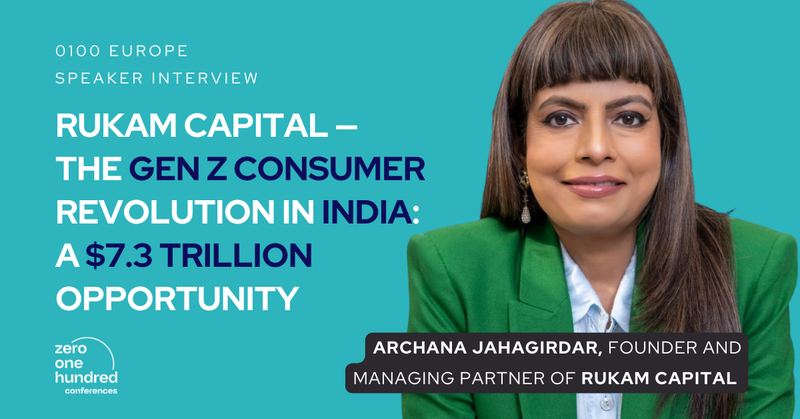
India’s consumer market is expected to grow to $7.3 trillion by 2030, driven by a young and aspirational population. For a global investor who still views India primarily as a technology or outsourcing story, what is the case for considering Indian consumer goods as a serious asset class?
India’s consumer story today is no longer a derivative of its technology narrative; it is a standalone structural growth opportunity. What international investors often miss is that consumption makes up 57–58% of GDP and remains the largest contributor to economic activity.
Government data continues to show that India’s GDP growth, in excess of 7–8%, is being driven by domestic demand despite global uncertainty. This is underpinned by rising per capita income, increasing formalisation, and deeper digital penetration, all of which are fundamentally reshaping consumption patterns.
One of the most defining shifts within this consumption story is the rapid rise of quick commerce, which is projected to grow at over 40% annually until 2030. This reflects how consumer expectations around speed, convenience, and access are evolving across categories and geographies.
At the same time, India is steadily moving towards higher discretionary spending, creating long-term headroom for premiumisation. For international investors, this translates into a multi-decade opportunity to back emerging consumer brands, similar to what China witnessed a decade ago.
If one wants to tap into India’s future growth, it has to be through the country’s consumption engine.
Gen Z already controls 43% of India’s discretionary spending and is on track to reach 50% dominance by 2035. As someone who has been backing Indian consumer brands since 2019, how has your investment thesis evolved to reflect this generational shift — and what does it mean for founders pitching to you today?
We are experiencing not just a demographic change but a complete reimagining of the idea of consumption in India. Our thesis since 2019 has shifted from investing in products to investing in relevance. Gen Z is value-driven, highly connected, and driven by issues of identity, community, and purpose.
We are therefore investing in startups that design their products for discovery-based environments, have clear differentiation, and resonate culturally instead of serving a functional purpose. The speed of iteration, a great match between founder and brand, and scaling trust have become increasingly important.
From the perspective of the founder, this implies that they cannot fit Gen Z into their business model, but rather need to incorporate it in a way that is native to the process of creating the product. What really excites us are founders that know how to trigger consumption among Gen Z and leverage data effectively to build a scalable brand in the coming decade.
Consumer goods are often seen as less exciting than technology or AI investing. How do you respond to that perception — and what have you seen in your own portfolio that proves the return potential of backing the right consumer brand early in India?
Investment in the consumer segment today cannot be viewed in isolation from technology or AI. The most compelling consumer brands we see are, in fact, deeply tech-enabled businesses. Everything, from demand generation to supply chain management, personalisation, marketing, and retention, is driven by AI. Therefore, it is not a matter of consumer vs. tech but rather how well the consumer brand uses technology to scale up.
This equation becomes even more interesting in India because of tailwinds in the digital infrastructure. Thanks to UPI, social commerce, and direct-to-consumer distribution, brands can now grow fast and scale up faster. However, what makes for a winner is the ability of the brand to leverage brand instinct as well as data-driven decisions to drive outcomes.
The early signs of this combination are visible in our portfolio at Rukam Capital. Some of the best examples are brands that operate digitally native, are community-first and operationally disciplined, resulting in strong repeat behaviour, better unit economics, and a quicker path to profitability.
Investing in a consumer brand in India today is therefore about betting on founders who can marry aspiration with analytics. It is the combination of brand, distribution, and technology that creates sustainable value.
Your research shows that UPI transactions in India have grown from under 1 million per month in 2016 to over 16 billion per month today, and the D2C market has gone from $6 billion to nearly $80 billion in under a decade. What does that infrastructure buildout mean for investors looking at Indian consumer brands right now — is the timing better than ever?
Our report, Aspirations of New India, pointed towards changing behaviour patterns, so much so that nearly 70% of consumers are confident about transacting online, while more than half are discovering and buying brands digitally. Moreover, more than 60% of the Gen Z population makes purchases based on social media recommendations, which increases discovery and adoption of brands.
This presents a definite inflection point for investors. Brand building isn’t limited by physical distribution anymore, and brands can now go nationwide in their reach from day one, establish direct relationships with consumers, and innovate constantly based on feedback.
But at the same time, the expectations of brands have increased. Consumers now demand a smooth experience, fast deliveries, and quality that meets international standards.
In short, the timing couldn’t be better, but the key would lie in establishing consumer trust, having clear positioning, and providing consistent value.
Fund II targets sectors like pet care, jewelry, home décor, and single-specialty healthcare — categories you weren’t backing in Fund I. What signals in Gen Z consumer behavior specifically drove you to expand into these new verticals, and which of them excites you most right now?
What emerged strongly from our Aspirations of New India report is that Gen Z consumers are not just increasing their spends, they are reallocating them toward categories that deliver tangible value, self-improvement, and personal expression. This shift is fundamentally reshaping where and how consumption is happening, and that’s what informed our expansion into newer sectors with Fund II.
Categories like pet care, home décor, jewellery, and single-specialty healthcare are seeing this play out in different ways. Pet care, for instance, is driven by the ‘pet-as-family’ mindset, leading to higher, more consistent spending. Home décor and jewellery are increasingly becoming everyday expressions of identity rather than occasion-led purchases. Healthcare, especially single-specialty formats, is benefiting from a more proactive, preventive approach to wellness among younger consumers.
Our investments reflect these structural shifts. WiseLife is exciting because it captures the mainstreaming of wellness as a daily, habit-led category with strong repeated behaviour. Similarly, Antinorm aligns with a clear consumer pivot toward minimalistic, effective beauty, moving away from complex, multistep routines to simpler, more intuitive solutions.
The best part about it all is that even though the behaviours are scaling up very fast, there’s still a huge, untapped potential in these segments. It gives new age brands a tremendous opportunity to formalise the segments, develop trust, and differentiate themselves as leaders within their respective categories.
Gen Z in India is simultaneously drawn to homegrown brands and to products popular in other cultures — nearly 60% of your survey respondents have purchased from brands with international appeal. As a VC, how do you think about backing Indian consumer brands that can win both at home and globally?
This trend observed in Gen Z is not an inconsistency but rather a definite pointer of future trends in the market. Our “Aspiration of New India” survey proves that, while the strong preference towards authentic and culturally relevant brands from India is obvious, almost 60 percent of consumers find brands with global appeal equally attractive.
This finding corroborates the fact that Gen Z follows the “Indian at heart, global in appeal” ideology. Brands that will seamlessly bring in an understanding of consumers’ needs and insights to bring in products and services that match world-class quality standards will ultimately win the competitive battle.
See, Gen Z is culturally savvy and a digital native, and therefore makes no distinction between Indian and global. Appeal is also an important driver in product purchase journeys. Understanding and navigating through these trends, we at Rukam Capital believe in founders who can intricately bring forth culturally savvy and purposeful brands with the potential to go far beyond India and become global leaders. With global markets now more accessible than ever, it is important for brands to have a definitive global strategy and have the ability to scale operations to meet growing demands.
Archana Jahagirdar will be exploring these themes in person next week at 0100 Europe in Amsterdam, in a fireside chat moderated by Charlotte Hughes-Morgan, Reporter at Bloomberg.